Trading Strategy with Trend Channel
A trend channel is formed when the market is trending. Trading based on a trend channel has a relatively high probability of success as long as the channel is valid. The higher the time frame, the more valid the channel. This article exemplifies trading with a trend channel on a 4-hour time frame.
Trend channel is one of the patterns that often forms on trading charts. A channel or range of price movement can always form whether the market price movement is trending or sideways (ranging). A trend channel is a channel that forms when the market is trending. Trading based on trend channels is relatively simple with a fairly high probability of success as long as the channel is valid. If you notice, the higher the trading time frame, the more valid the trend channel becomes. This article illustrates a trading strategy using trend channels on a 4-hour time frame.
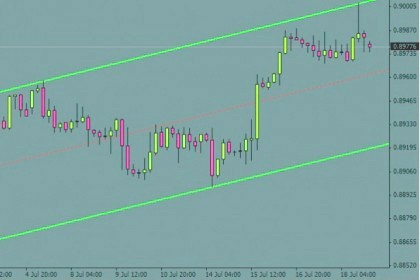
An uptrend channel is formed from parallel lines drawn above the uptrend line when the price movement starts to reverse from a high point, while a downtrend channel is formed by parallel lines drawn below the downtrend line when the price movement starts to reverse from a low point. The trend channel shows the consistency of market movement in adhering to the trend lines.
Here is an example of an uptrend channel on EUR/AUD 4-hour time frame:
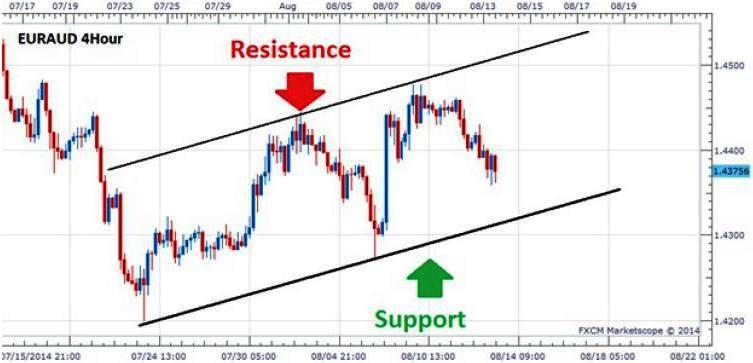
First, draw a support line created by connecting the two nearest support levels, and a resistance line drawn from the lowest high level parallel to the support line. Support points are visible on the support line (uptrend line) and resistance points on the resistance line. Both lines must be parallel to confirm the formation of an uptrend channel, while support and resistance points do not have to be exactly on their respective support or resistance lines. This is in accordance with the characteristics of an uptrend, which is the formation of higher low levels or lows that are higher than the previous low, and higher high levels or highs that are higher than the previous high. Conversely, for a downtrend channel.
Determining entry and exit levels
After the trend channel is identified, the next step is to determine the entry and exit levels (stop loss and limit or take profit). Trading with trend channels is essentially the same as trading based on support and resistance points, similar to strategies often applied in sideways conditions, so entry and exit can be at those points.
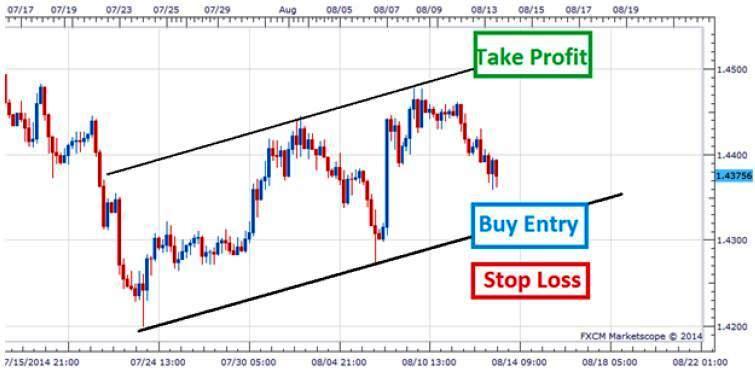
For an uptrend, the easiest way is to enter a buy at the support level confirmed by an oscillator indicator to determine the right entry time when the market condition is oversold, or enter a sell at the resistance level when the market is overbought. Commonly used oscillator indicators include RSI, stochastic, or CCI.
For a buy position, the stop loss can be set a few pips below the support level with the assumption that if the price moves below the nearest low level (which means the uptrend channel is no longer valid), we can exit quickly. For the limit or take profit level, it can be set a few pips below the resistance line with the assumption that if the price reverses before touching the resistance line, we can still exit. The opposite applies for a sell position. Typically, trading with this strategy will yield a risk/reward ratio greater than 1:1.