Signs of a Scam Broker
A scam can be defined as fraud or deception that lacks transparency. Below are some common signs of scam brokers that every trader should pay close attention to.
In this context, a scam also refers to dishonesty or deceptive practices that violate basic trading ethics. The following indicators can help you identify whether a forex broker may be operating as a scam. You can refer to the video or read the detailed explanation below to better understand the warning signs of a scam forex broker.

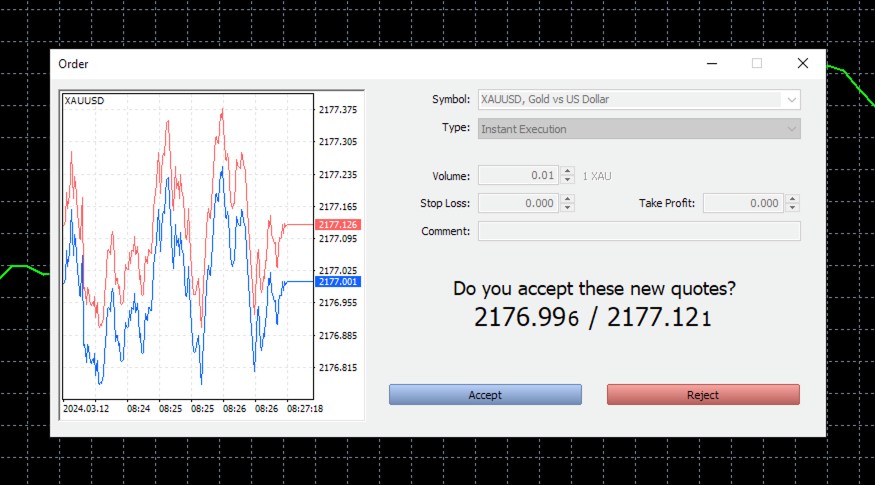
Requote |
A requote occurs when the price changes at the exact moment a trader attempts to execute an order. Frequent requotes, especially when market volatility is low, can be an abnormal sign and may indicate that the broker is interfering with the order execution process. This behavior is commonly associated with scam brokers.
Freeze or Downtime |
This refers to situations where the trading server freezes, lags, or temporarily stops updating price data, causing charts or trading platforms to appear unresponsive. Such conditions may occur during extreme market volatility. However, if your forex broker frequently experiences freezes under normal market conditions, this could be a suspicious warning sign.
Stop Loss Hunter |
Stop loss hunting refers to practices where a broker or market manipulator deliberately pushes prices to trigger traders’ stop-loss orders, resulting in unnecessary losses. This predatory behavior is often found among scam brokers or unregulated platforms.
At stop-loss levels, the broker’s system may execute orders unusually fast, making traders feel as if their positions are being deliberately targeted. For dealing desk brokers, this behavior can generate profit for the broker while causing losses for traders.
In contrast, at take-profit levels, order execution may feel noticeably slower. Slippage may occur, or orders may get stuck. For example, a take-profit target of +50 points may only be executed at +30 to +40 points. When profits are small, such as +5 points, prices may suddenly reverse or close prematurely, ultimately resulting in a loss.
Price Manipulation |
Some brokers advertise low spreads, but in reality, actual trading conditions tell a different story. When a trader opens a position and the price moves in the expected direction, the broker’s system may intentionally slow down execution. As a result, even if the advertised spread is fixed at 2 or 3 points, the real entry price may be worse by -5 or -7 points.
Conversely, when the price moves against the trader, the order is often executed immediately.
Non-Standard Domain Name |
Another sign of a potential forex broker scam is the use of an unreliable or uncommon domain name. Legitimate brokerage firms typically use well-established domains such as .com or official regional domains like .com.vn or .co.id.
Be cautious if a broker’s website uses less common domains such as .net, .org, or .biz. Extra caution is needed if the broker relies on free blogging platforms like blogspot.com or wordpress.com. That said, many sophisticated scam brokers now use .com domains, so the domain type should only be considered as one reference, not the sole deciding factor.
In summary, broker fraud remains a serious issue, especially for new traders. One of the most effective ways to avoid scams is to check broker ratings and rankings on reliable forex broker review platforms.
Forex Broker Name |
Scam brokers often use unusual, confusing, or forced-sounding brand names. For example, names like “4x”, which loosely resemble the word “Forex,” may indicate a lack of professionalism and unclear brand identity.
Headquarters Address |
Scam brokers are often registered in small, remote, or obscure countries commonly known as offshore locations or tax havens. These addresses are frequently shared with online gambling platforms or fraudulent investment schemes.
Trap of Promotions and Bonuses |
Traders should remain cautious when encountering brokers that offer extremely attractive promotions, such as deposit bonuses of 200 percent or more. Legitimate forex brokers focus on safety, transparency, and service quality rather than relying on flashy bonuses that often come with hidden conditions.
It is important to remember that no broker offers bonuses without expecting something in return. The larger the bonus, the stricter the conditions and the higher the risk of future problems. Many traders have experienced situations where they received bonus funds but were later unable to withdraw profits due to unclear or restrictive terms.
Regulatory License |
A legitimate brokerage firm must hold an official operating license issued by a recognized financial regulatory authority, usually under the supervision of the government where the broker operates.
A forex broker without a regulatory license operates without oversight, allowing activities to be conducted arbitrarily and exposing traders to significant risk. The long-term stability of such brokers is also highly uncertain.
For higher credibility, brokers should be regulated by authorities in developed countries rather than offshore jurisdictions. Traders should also be alert to fake regulatory claims and must verify licenses directly through official regulatory websites.
Recognized forex regulatory authorities include:
- NFA or CFTC in the United States🇺🇸
- FCA in the United Kingdom🇬🇧
- ASIC in Australia🇦🇺
- CySEC in Cyprus🇨🇾
Among these, NFA or CFTC, FCA, and ASIC are considered the most reputable and strict regulators.
Processing Speed & Payments |
A forex broker that frequently delays withdrawals is a strong warning sign. When deposits are processed instantly but withdrawals take an unusually long time, transparency and fairness are questionable.
While international bank wire transfers may take longer due to cross-border procedures, withdrawals via credit cards or online payment systems such as Fasapay or WebMoney should typically be completed within one to two working days.
If a broker repeatedly violates its own withdrawal terms, traders should seriously consider leaving. Examples include withdrawals promised within two days but completed after five days, unexplained deductions from withdrawal amounts, or delays exceeding five working days without clear justification. These are strong indicators of a scam broker.
How to Avoid Scam Forex Brokers |
Forex brokers play an essential role in enabling traders to participate in the forex market. However, the presence of scam brokers makes careful selection critical.
Based on the analysis above, traders can reduce the risk of scams by checking whether a broker is regulated by a recognized authority, identifying whether the broker operates as a dealing desk or non-dealing desk, and assessing the broker’s reputation through user reviews and market visibility.